This is, as noted before, the 100-year anniversary of the first year of World War I.
History is made of competing forces. Between the Great Man and the Social Movements lie all the conflicts of both. By 1914, these forces had congealed on the European continent through a combination of set nations - France, Germany, Russia, the UK, Italy, Austria-Hungarian Empire, and Ottoman Empire - and a burgeoning psycho-social ideology of Nationalism fighting over pride and global power.
It had been 100 years in the making by then. In the aftermath of the Napoleonic empire and swath of republicanism, Europe suffered through a period of nation-building border wars - the Greek independence war, Italian reunification, Prussian unification of a greater Germany - that concluded with the Franco-Prussian War in 1870-71.
What had been viewed at the time as a likely win for France - larger armies, better organized - turned into a full rout in Prussia's favor in a war that barely lasted a year. France was abjectly humiliated as a result (this is where the meme of France being terrible in wars started), Germany rose up to disrupt the standard balance of power - once it was England vs. France, no longer - in Western Europe, and the Victorian Era switched from being a period of scientific advancements to one big mechanized military arms race.
The problem was that the Victorian (and later Edwardian) Era became this period of an idealized, improved social condition. Things like personal honor, stiff upper lip, gentlemanly codes became more fetishized. A lot of it had to do with the literature of the time. Some of it with the changes in economic and social fortunes creating a middle class striving for cultural norms of its own, to where the upper classes indulged in sharing the more romantic elements of their lifestyles.
By the time the fighting in World War I actually started, nearly everyone went into it with these grand notions of honor and soldiering. That it was all parade marches and sacrificial charges into waiting hordes of bayonets and swords. Nobody really thought about the improved rifles and automatic guns, or the advancements in artillery fire and targeting, or the armored tanks that were new to the battlefield, or the effectiveness of barbed wire and hand grenades and poison gasses.
By the end of the calendar year of 1914, Western Europe's battlefields were basically two extended mud trenches and two massive armies - Germany in one trench, UK and France in the other - staring at each other across a cold no-mans-land. The Germans were the ones who made the efforts to decorate their trenches for the holidays, and via the honored soldiers' code of "Live and Let Live" (under which both sides agree to temporary cease-fires to recover wounded or personal belongings), the Germans sent messages to their British and French counterparts about holding a truce - THE Truce - during Christmas Day.
There aren't a lot of documents about it, mostly from a good number of diary entries and remembrances of those who were there that day, so a lot of the Christmas Truce has fallen into legend. Above all the legend of a football (soccer to us Yanks) game being played between the two armies. There's no evidence it happened, but the story is that Germany won 3-2. It'd have been tied but that damn ref called Blackadder offsides.
Whatever history there is of this - the legends still tell us - the generals were not amused their soldiers weren't killing each other. When the areas where the Truce were continuing on after Christmas had passed, the chain of command ordered artillery barrages and switched out the divisions stationed there with fresh troops to ensure the fighting started up again. By 1915, the generals planned ahead and made sure they had artillery barrages scheduled for Christmas to prevent the troops from making another try at a truce. By 1916, they didn't bother: the bloodshed between both sides - and the use of chemical gas weapons - ensured the troops were in no mood for cease-fires.
Looking back on the Christmas Truce, it reminds us that the war was fought by men looking not for glory - that madness was left to the generals - but because it was expected of them. Where the soldiers in the trenches had more in common with each other than the officers in their headquarters five miles back. The Truce was part of an era of that Victorian/Edwardian mindset of honor between soldiers regardless of which flag they fought for.
It was an era that was dead in the trenches by 1918.
And yet, we remember. We remember the Truce as a good thing, a moment in human history at the edge of a terrible war where there was still hope and the potential of friendship past the hardship. As a nice little Christmas candle shining in the darkness of the 20th Century.
Merry Christmas to ye, fallen soldiers of that and all other wars, before and after. The Truce remains to us as a memory of what we all can achieve some day.
A chance of playing an honest game of football and not get shot at for it.
Soon, those who remember the assassination of John F. Kennedy will fade into history. All who remain behind will know only of the Buttfumble this dark day (It already has its own separate Wiki entry!).
Feast well, this coming day of pagan sacrifices to elder gods seeking the meat of turkey. I will post more on that when the time comes.
Also, I'm currently at 40,000 words on NaNo and aiming for 42,000 by tonight.
The Berlin Wall was a big damn deal: a symbol of the Cold War struggle between the western democratic-republican nations and the Soviet-Russia dominated authoritarian regimes.
The fall of the Wall signaled the beginning of the end of the Eastern Europe communist bloc (it wouldn't be truly finished until the failed August coup of 1991).
It's difficult to describe to anyone who hadn't lived through the Cold War era: the minor but constant dread that war between East and West would flare up; the constant proxy wars in foreign lands that perpetuated social ills for Third World nations playing up to their First World paymasters; the ideological sterility of two opposing political philosophies...
The fall of the Wall changed all that. We could see in real time as it happened, as people celebrated on a barricade over which people died trying to cross, as they began bringing pickaxes and crowbars to start carving chunks of the Wall out, taking down entire sections, brick after brick falling away...
It's still one of my biggest regrets, not getting a chance to travel to Berlin and leave some graffiti on the West's side of the wall. Ah well. This is a better result.
And damn, I'm getting old... TWENTY-FIVE YEARS already?
Last year, I was worried about how the world had remained a bloody, violent place since 2001 as the Syrian Civil War was well into its third year. It's now in its fourth, and due to the extremist group ISIL it's bled over back into neighboring Iraq which still hasn't recovered from the ill-planned Bush/Cheney occupation.
Last night Obama gave a speech outlining how we were committing airstrikes against the Islamist State psychopaths. We are remaking military commitments to a nation we tried to exit back in 2011, mostly because we as a nation failed to leave Iraq in better shape than when we invaded it in 2003. Mostly because we dove head-first into a Middle East quagmire out of anger and blind rage.
We had no reason to invade Iraq in response to what Bin Laden did to us on 9/11. The reasons were fabricated by a Bush/Cheney administration that wanted to invade Iraq for other objectives (finishing off Saddam, placating our allies in the region who didn't like having a dictator for a neighbor, seizing all that oil and natural resources). We had no plan for what to do with nation-building. Well, there was a plan: remove Saddam and his ilk, put in pet Chalabi on the throne, sign up all the oil rights, exit Iraq. When it happened that nobody in Iraq wanted Chalabi and he wasn't the puppy Cheney thought he was, it turned out we had no Plan B.
Because with the Middle East there IS no Plan B. Just an ongoing, 5000-year cycle of violence and madness that will only end when everybody's dead.
And we are all stuck. The innocent people in the Middle East trapped between warring factions. Other nations tied to the region through all that damn oil. A United States that's morally and politically obligated to keep dropping itself into that quagmire because we've been breaking things there since World War II and we're stuck paying the bills for the next century.
We're bombing away in Iraq today. Because the Towers fell thirteen years ago. We have no idea when we can stop bombing.
It is, yet again, August 16th and time to remember back to Woodstock.
Why? Why so much nostalgia for a concert I never attended (I was born 1970, nine months later... and no, my parents were in Spain at the moment...)?
Because, as a student of history, the moment appeals to me.
Coming at the end of a turbulent decade - the 60s - the concert was a royal f-ck-up, a disorganized mess, the promoters just a bit overwhelmed by the scale of their initial attempt and ill-prepared for the turnout that showed up (eventually 400,000 to 500,000 people, practically a major city). They didn't have enough food or water, not enough security, poorly planned parking and traffic (it is not exaggeration to say that the concert shut down the southern half of New York state traffic).
It didn't help the surrounding communities either to have 500,000 show up unexpected on their doorsteps. Bethel NY in particular bore a huge brunt of the problems, primarily helping out with keeping hundreds of thousands of concert-goers fed. God bless 'em though, the people who lived there helped:
And that's kinda why I think fondly of Woodstock: people were for the most part good. Good to each other. Sure, there may have been a handful of people overpricing stuff or ripping others off, but those seem so few and far between and I can't find a lot of evidence about that.
There were only two deaths out of 500,000 people: one a heroin overdose and the other an accident involving a runaway tractor. Almost no major fights, at least nothing reported to the local hospitals. And most of what the hospitals handled were broken bones and medical emergencies.
And the key thing, about it being the Sixties: the concert-goers and the local police got along. We're talking about the turbulent protest era, over civil rights and against the Vietnam War, where nearly every major march ended up with cops in riot gear launching tear gas and swinging batons at the dirty hippies. The majority of the concert-goers were young and anti-war protesters. There was a lot of drug use: a good amount of pot, and remember watch out for that "brown acid". Any one of these things could have set the cops into Riot Control mode on top of the fact they had 500,000 people stumbling about Max Yasgur's farm.
The local police, however, tried something I'm surprised most police forces don't even apply 40 years later: a Soft Power approach of keeping the peace, where they didn't line up to intimidate the crowds with snipers and guys in body armor, but allowed the hired security people - most of them off-duty or ex-cops already - to patrol and handle the crowds. The decision came down to avoid going after the drug users: the reality that a lot of attendees were gonna get high made detaining any of them a logistical nightmare.
Somewhere and somewhen, the local police tried treating the concert-goers not as rioters but as people. And the results worked:
"...Not withstanding their personality, their dress and their ideas, they were and they are the most courteous, considerate and well-behaved group of kids I have ever been in contact with in my 24 years of police work," Lou Yank, the chief of police in nearby Monticello, told The New York Times...
Treating each other with respect tends to be a two-way deal. And it made the Woodstock Festival work well enough that 45 years later everyone involved in it can look back with some small pride of being part of one of the biggest non-violent events in world history.
Sad to say, compared to the problems we've got whenever a protest or gathering forms anymore:
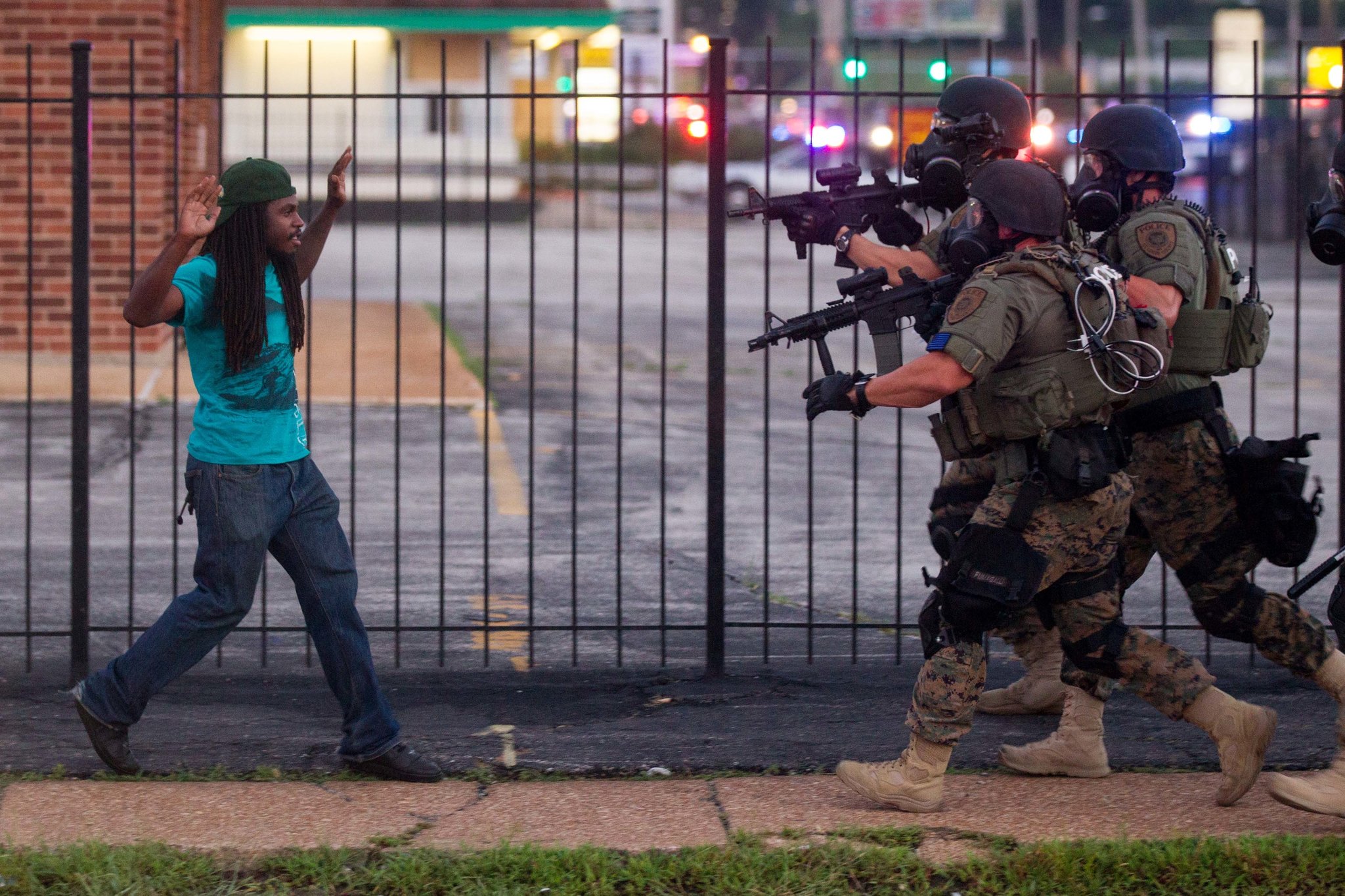
These are pictures from the first few days of protests in Ferguson Missouri after an incident where a cop shot an unarmed black teen in the back under questionable circumstances. The local city and county police decided to bring in riot gear, body armor, snipers, and more personal firepower than most of our armed forces didn't deploy with during their tours of Iraq and Afghanistan (the quote sticking with me from an article from Business Insider: "We rolled lighter than this in an actual war zone"). And the county and city cops used rules of engagement that pretty much ensured rubber bullets and tear gas went flying everywhere, especially by Wednesday night.
It got bad enough that the state Governor forced the Ferguson PD and county law enforcement to stand down, sending in the state highway troopers to keep the peace. And they went in like this:
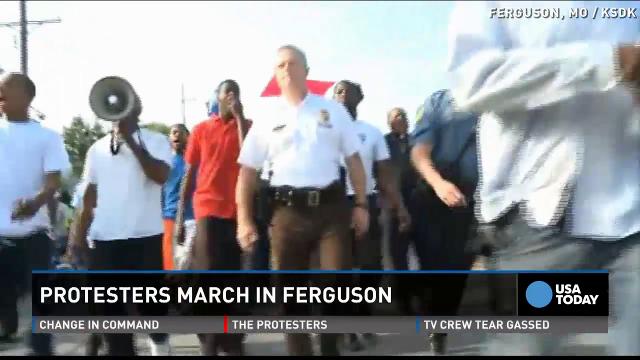
The state troopers went in talking, not shooting. Walking with the protesters. Mingling. Hugging.
Wednesday night had violence. Thursday night had hugs. Notice a difference...
This is why we gotta remember Woodstock. Everybody - the police, the civilians, the neighborhoods, everybody - went in on their best behavior, and everything worked out for the best. Lessons that need to be learned.
On this day in 1974 President Richard Nixon went before the nation and offered his resignation, effective the next day. Gerald Ford, recently installed as Vice President, would be sworn in as President on August 9.
What began as an investigation into a puzzling break-in at the Democratic Party's headquarters in the Watergate Office Complex in June 1972 turned into a revelation of reckless law-breaking by a political campaign awash in slush money, political dirty tricks, warrant-less wire-tapping, interdepartmental warfare reaching well into the White House itself, and Paul Newman being on Nixon's Enemies List.
The rot with the Nixon administration was top-down, but up to a certain point most of the damage to Nixon himself wasn't threatening to his position (when the November 1972 vote was held, Nixon still won because most voters didn't think Watergate or the cover-up attempts involved him).
By 1974 the situation changed. The revelation in 1973 that Nixon had been taping all conversations in the Oval Office (it was actually a practice begun during the FDR years, but not to the extent Nixon set up) created a Constitutional crisis. The relationship - the system of checks and balances - between the three branches of the federal government were strained to a point not seen since the start of the Civil War, especially between the Executive and Legislative branches. Court fights over the tapes and transcripts carried on for over a year. By the time the Supreme Court ruled 8-0 in US v Nixon in favor of releasing the tapes, we were facing the likelihood of a President openly defying SCOTUS as well as defying Congress itself.
Impeachment - the removal of the President for criminal or unethical misconduct - was openly discussed. And seriously - as opposed to other moments - considered...
The history of impeachment itself as a mechanism for cleaning corrupt officials out of power is kinda checkered. For non-elected and (usually) non-partisan officials like judges, the system was even-handed. There'd only been 62 proceedings in the House to consider impeachments, with only 19 proceeding to the Senate since 1789 up to today, making it a rarely used process. But when it comes to the big chair of the Presidency... well...
In the review of Presidential character I did last year, I pointed out - in cases like John Tyler and Andrew Johnson and Bill Clinton - that the partisan nature of the fights between the White House and Congress skewed the need to impeach. As I said in a follow-up:
...Congress talked impeachment only rarely: in a case like John Tyler (when Tyler seemed to betray the Whig Party on a personal level); and in a case like Andrew Johnson (when party foolishness put a Democrat in the line of succession, leaving a Radical Republican Congress to reach for any excuse to purge him). The impeachment process against Tyler went nowhere because the Whigs couldn't garner enough votes in the House: the impeachment against Johnson came one vote shy of success, which historians still argue was the closest we'd ever gotten to a political coup in our nation's history. Both times, impeachment was used as a means to remove a President simply because of ideological conflict: neither one really broke the law (technically Johnson broke the Tenure of Office Act, but that law was specifically written against him, and the courts ruled it unconstitutional), they both were radically opposed to what Congress wanted...
This is the danger of impeachment: meant to be a tool to remove a powerful political figure that might otherwise be above the law, impeachment has rarely been used as such (only once)...
You'll notice that I gave one exemption ("only once"): that exemption was Nixon.
As Watergate's revelations unfolded, even the partisan backers of his own party - Republicans - began to step away. Unlike Tyler and Johnson, there was something criminally wrong with Nixon's White House that even the most biased supporter couldn't defend. It didn't help Nixon that the Congressional investigations especially in the Senate were fronted by respected pols - Sam Ervin and Howard Baker - known for their bipartisan work.
As long as Nixon kept hidden any evidence of criminal wrong-doing, of unethical activity, he was still safe behind the argument that Watergate was a political witch-hunt. Which was why he and his lawyers fought hard to keep those tapes away from the public. When the Supreme Court said that the tapes had to come out, there was nowhere to hide. Other than outright law-breaking, full shutdown of the government, a White House coup making Nixon full-on dictator...
If there was anything in Nixon's soul, even it balked at taking that one step. Nixon turned over the tapes.
The House Committee considering impeachment charges voted on July 27 to charge Nixon with obstruction of justice with a 27-11 vote, with enough Republicans on the committee voting for it. The "smoking gun" tape - the one that caught Nixon telling six days after the Watergate break-in to get the CIA to block the FBI investigation, specific proof of obstruction - went public August 5th.
Rather than face the ignominy of being the first President ever impeached - a legitimate possibility, one even Andrew Johnson was able to avoid - Nixon resigned.
It's never been that close a call.
In Andrew Johnson's defense, the law he was getting impeached over was a sham. In Bill Clinton's defense, his actions trying to hide his affair with Monica Lewinsky didn't rise to an impeachable offense. In all the other cases where impeachment was argued, pursued, wished for - Tyler, Bush the Lesser, and Obama (present tense) - the stench of partisan obsessiveness made it too reckless and either failed on a floor vote or failed (and should fail in Obama's case) in committee.
It was forty years ago, we came this close to a genuine impeachment trial, and for all that meant. It was forty years ago our nation pulled back from a very dangerous political cliff.
Before the day goes by, today is the 45th anniversary of one of mankind's greatest achievements:
With all congratulations to the late Neil Armstrong, to Buzz Aldrin, and to Michael Collins (who had to stay in the Command Module) for their historic flight there and back.
And also, due to their efforts, we were able to contribute to one of the best episodes of the television show Mad Men:
And with that "Bravo," Bert Cooper passes on... and later on that episode, Don Draper witnesses Bert's ghost sing "The Best Things In Life Are Free" in a mind-blowing (there are layers of symbolism behind this that would take a 20-page journal essay to spell out) closer: The song, the setting, the moment... all because we as the human race achieved the moon. We haven't really moved on from that moment - the technology can't sustain ourselves for long out there, so we're still on this fragile blue ball - but if anything out of all the wars and madness, we made it. It may have cost a fortune, but we made it. And it was a moment everyone back then shared... a moment we all share today, and it was in a way free for all.